
Branding for small business is one of the most misunderstood topics in the entrepreneurial world. Ask most small business owners what “branding” means, and nine times out of ten, they’ll point to their logo. It’s an understandable assumption — the logo is the most visible piece of a brand, so it’s easy to think it is the brand. But that assumption quietly costs businesses customers, trust, and revenue every single day.
A logo is one small piece of a much bigger system. Branding is the entire experience someone has with your business — what they see, what they read, how you speak to them, and whether all of it adds up to something they trust enough to buy from. A business can have a beautifully designed logo and still lose customers because its website looks outdated, its Instagram feed looks inconsistent, or its overall presence feels unprofessional and scattered.
In this article, we’ll break down what proper branding for small business actually includes, why it matters far more than most owners realize, and exactly how to start building one properly — even on a limited budget.
Table of Contents
What Does Branding for Small Business Actually Mean?
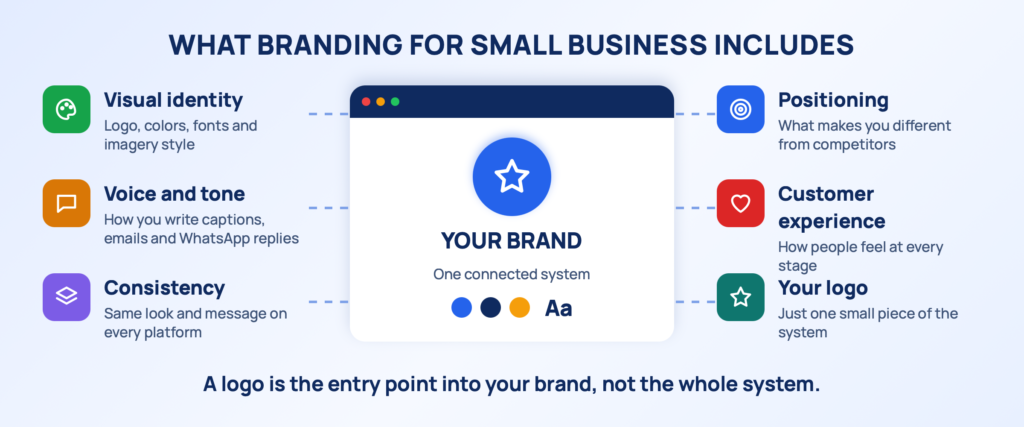
Branding for small business is the sum of every visual and verbal signal your company sends to the world. It includes:
- Visual identity — your logo, color palette, fonts, and imagery style
- Voice and tone — how you write captions, emails, website copy, and even WhatsApp replies
- Consistency — using the same look and message everywhere your business shows up: Instagram, your website, business cards, invoices, packaging
- Positioning — what makes you meaningfully different from competitors in your space
- Customer experience — how people feel at every stage of interacting with your business, not just when they first see your logo
A logo is the entry point into this system — not the whole system itself. Think of it like a book cover. A great cover gets someone to pick the book up. But it’s the story inside — consistent, well-written, coherent — that makes them finish it, remember it, and recommend it to someone else.
Why a Logo Alone Isn’t Branding for Small Business
Many small businesses invest in a logo, feel a sense of accomplishment, and assume the branding box has been checked. Here’s why that assumption falls short in practice.
1. Inconsistency quietly breaks trust
If your logo looks premium and professional, but your Instagram posts use five different fonts and clashing colors, customers notice the disconnect — even if they can’t fully explain why something feels “off.” This subtle inconsistency signals, without anyone saying it out loud, that the business isn’t fully put together.
2. A logo can’t explain your value
Your logo cannot tell someone why they should choose you over the three other similar businesses they found on Google. That job belongs to your messaging, website copy, service descriptions, and positioning — none of which live inside a logo file.
3. Logos alone don’t build memory
Brand recall isn’t created by a single image seen once. It’s built through repetition — the same colors, the same fonts, the same tone, shown consistently across every platform a customer might encounter you on.
4. Customers buy trust before they buy the product
This is especially true for service-based businesses, where the customer can’t physically inspect what they’re buying before committing. Underneath the surface, potential customers are really asking themselves: “Can I trust this business to deliver?” That trust is built through consistent, professional presentation — not through a single polished graphic.
How to Build Proper Branding for Small Business (Step-by-Step)
If you’re building your brand from scratch, or fixing one that feels scattered, here’s a more effective order of priorities than “just get a logo made.”
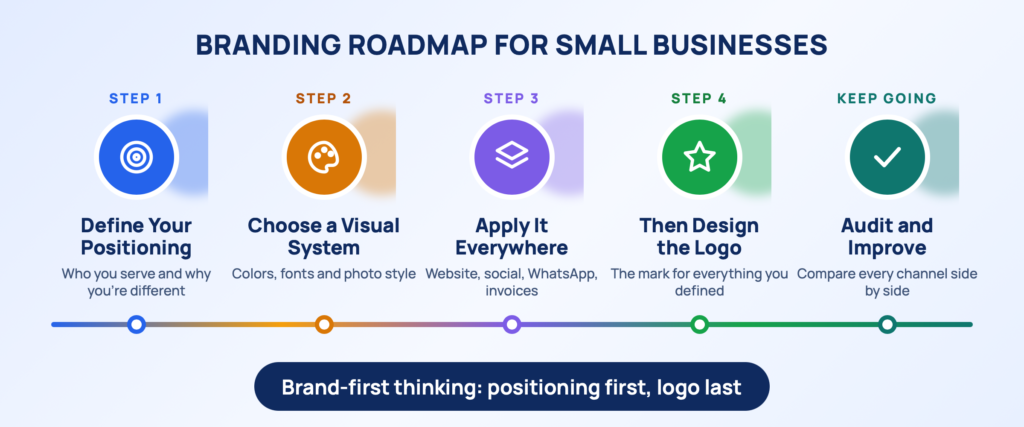
Step 1: Define Your Positioning First
Before any design decisions are made, get clarity on three things:
- Who your business actually serves (be specific — “busy working professionals in Chandigarh” beats “everyone”)
- What problem you solve better than the alternative of not hiring you at all
- What makes you different from other businesses offering similar services in your city or niche
This foundational clarity should inform every design choice that follows. Skipping this step is why so many small business brands feel generic — the visual design was decided before anyone answered these questions.
Step 2: Choose a Simple, Consistent Visual System
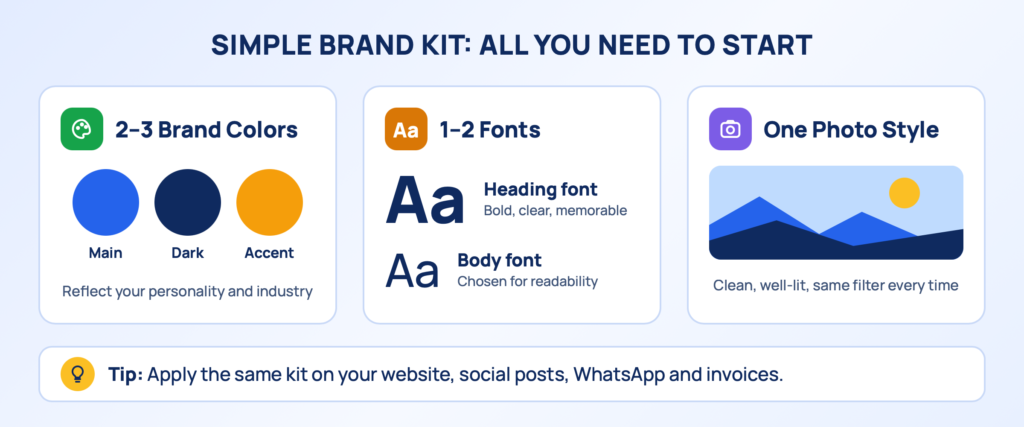
You don’t need an elaborate 40-page brand book to look professional. Start with the essentials:
- 2–3 brand colors that reflect your business’s personality and industry
- 1–2 fonts — typically one for headings and one for body text — chosen for readability, not just style
- A consistent photo or graphic style — for example, always using clean, well-lit product photography, or always applying the same color filter or template style to social posts
This simple system, applied consistently, does more for perceived professionalism than an expensive logo used inconsistently.
Step 3: Apply It Everywhere, Without Exception
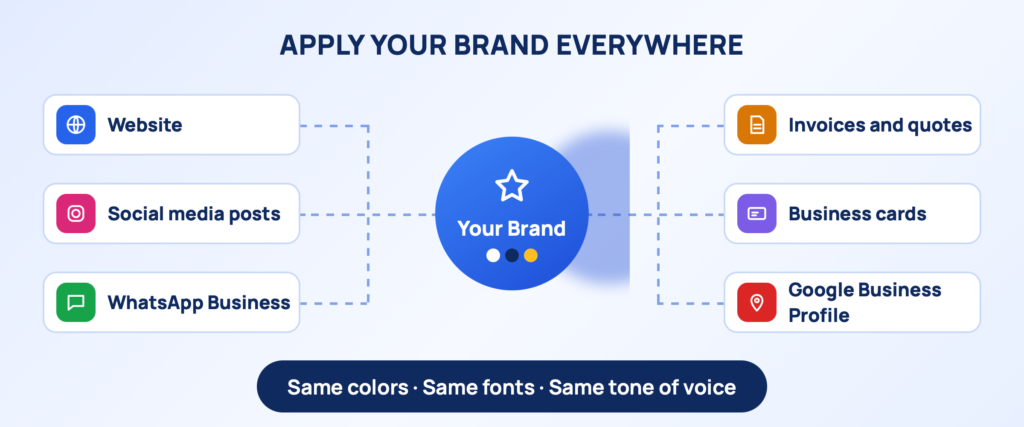
The same colors, fonts, and tone of voice should appear across:
- Your website
- Your social media profiles and every post you publish
- Your WhatsApp Business profile and message templates
- Invoices, quotations, and business cards
- Your Google Business Profile
This is where the majority of small businesses quietly fall short. It’s rarely that the logo itself is bad — it’s that the brand isn’t applied consistently everywhere a customer might look.
Step 4: Then — and Only Then — Design (or Redesign) the Logo
Once your positioning is clear and your visual direction is set, the logo design process becomes far easier and more focused. At that point, it’s simply the visual mark that represents everything you’ve already defined — not a starting point built on guesswork.
Signs Your Branding for Small Business Needs Work — Not Just a New Logo
Watch for these warning signs, which point to a branding problem deeper than the logo itself:
- Your website and your social media look like they belong to two unrelated businesses
- Customers frequently ask basic questions your website should already be answering clearly
- You struggle to explain what makes your business different in a single sentence
- Your fonts and colors shift depending on which platform someone finds you on
- Your overall look is indistinguishable from five competitors in your city
If several of these sound familiar, the real fix isn’t a new logo. It’s building — and consistently applying — a proper brand system.
How Much Does Branding for Small Business Cost?
Branding investment can vary significantly depending on scope, and it helps to understand the typical tiers:
- Basic logo only: Often underpriced, and incomplete as a standalone deliverable — it solves only a small part of the branding problem.
- Brand identity package (logo + color palette + font system + basic usage guidelines): A far more realistic and valuable starting point for most small businesses.
- Full branding + website + social media templates: The best option for businesses that are ready to invest in consistent, professional growth across every channel.
For most small businesses, the smartest move is choosing a complete, modest brand identity package over a cheap logo-only design. The price difference is often minor, but the impact on how professional and trustworthy the business appears is significant — and that difference shows up directly in conversion rates and customer confidence.
A Simple Way to Audit Your Current Branding
If you’re unsure whether your branding for small business needs work, try this quick exercise. Open your website, your Instagram profile, your WhatsApp Business chat, and a recent invoice side by side. Ask yourself:
- Do these all look like they belong to the same business?
- Are the same colors and fonts showing up consistently?
- Does the tone of voice feel the same across all of them?
- Would a new customer immediately understand what makes this business worth choosing?
If the answer to any of these is “no,” that’s your starting point — not a new logo, but a consistency and positioning fix.
Final Thoughts on Branding for Small Business
A logo is a symbol. Branding is the full experience built around that symbol — the positioning, the consistency, the voice, and the trust it creates over time. Small businesses that treat branding as “just get a logo made” often plateau early. They look fine in isolation, but nothing about their overall presence builds real trust or memorability with customers.
If you’re serious about growing your business in 2026, start with clear positioning and consistent application across every platform, and let the logo design follow naturally from that foundation. That shift — from logo-first thinking to brand-first thinking — is what separates a business people simply notice from a business people remember and actively choose.
Need help building complete branding for small business — not just a logo? Talk to our design team →